What is a sales funnel? It’s the path a stranger takes from first hearing about you to becoming a paying customer. The “funnel” part comes from the shape: lots of people enter at the top, fewer move through the middle, and a smaller group comes out the bottom as buyers.
You’ve been through dozens of them without noticing. You saw a video, clicked a link, grabbed a free guide, got a few emails, and eventually bought something. Somebody planned that path, and it worked.
In this guide, I’ll explain how a sales funnel works in plain English, walk through the stages, show real-world examples, and give you a simple plan to build your own. No jargon, no hype, just what actually matters.
What Is a Sales Funnel, Explained Simply
Let’s skip the textbook language.
Picture a market stall. Hundreds of people walk past every hour. A few slow down. Some of those pick something up. A handful ask the price. A couple buy.
Nobody at the stall is surprised that most people keep walking. The real question is how you help more of them slow down, pick up, ask, and buy.
A sales funnel is the online version of that. It’s a deliberate path with steps, where each step has one job: move the person a little closer to a decision. It’s not one page or one email. It’s a sequence.
Here’s the shape, in its simplest form:
- Someone discovers you. A post, an ad, a search result, a recommendation.
- They show interest. They visit your site, watch something, or download a freebie.
- They think it over. They compare options and wonder if you’re the right fit.
- They decide. They buy, book, or sign up.
- They stick around. They come back, refer others, or buy again.
Everything in funnel building comes back to those steps.
Why “funnel” and not “line”?
Because people drop out along the way, and that’s normal. A hundred visitors don’t become a hundred customers. Maybe thirty download your guide, ten reply to an email, three book a call, and one buys. That narrowing is the funnel shape, and it’s not a sign something’s broken. The goal is to make each step a little smoother so more people make it through.
A Short Story: The Coach Who Had Traffic but No Clients
Here’s a scenario I see all the time.
Say you’re a fitness coach named Dana. You post on Instagram every day. Your page grows. Your website gets a few hundred visitors a month. But clients? Barely any.
Dana’s setup looks like this: a visitor lands on her homepage, sees a long list of services, a “Contact Me” button, and nothing else. If they’re not ready to message a stranger, they leave. And most people aren’t ready to message a stranger.
Now picture the same business with a simple funnel. Her Instagram bio links to a free “7-Day Kickstart Plan.” Visitors enter their email to get it. They land in her contact list, get a welcome message, then a useful tip each day for a week. On day six, she mentions her coaching program and offers a free 15-minute call. Those who book get a reminder and a short questionnaire.
Same Dana. Same traffic. Same coaching. But now there’s a path, and people have a reason to take each step.
That’s the whole idea. Dana didn’t need more followers. She needed a way to guide the ones she already had.
The Stages of a Sales Funnel
You’ll see slightly different versions across the internet, but most boil down to these.
Stage 1: Awareness
This is where people first notice you. They may not even know they have a problem yet, or they know the problem but not the solution.
What works here: Helpful blog posts, short videos, social posts, search results, podcasts, referrals, and ads.
Your job: Be useful and easy to find. Don’t try to sell yet.
Stage 2: Interest
They’ve noticed you and want to know more. They might read a few of your articles or follow you.
What works here: Free guides, checklists, quizzes, email newsletters, short training videos.
Your job: Give them something valuable in exchange for their email address. This is where a stranger becomes a “lead.”
Stage 3: Consideration
They know you exist and they know you could help. Now they’re comparing you with other options and weighing whether it’s worth the money or effort.
What works here: Email sequences, case studies, testimonials, comparison pages, demos, FAQs.
Your job: Build trust and answer doubts before they’re even asked.
Stage 4: Decision
They’re close. They just need a nudge, a clear offer, or an answer to a last question.
What works here: Sales pages, free consultations, limited-time bonuses (only if they’re real), booking calendars, clear pricing.
Your job: Make buying easy and risk feel low.
Stage 5: Retention and referral
The funnel doesn’t end at the sale. Happy customers buy again and tell others.
What works here: Onboarding emails, check-ins, loyalty offers, review requests, referral programs.
Your job: Deliver on your promise and keep the relationship warm.
Notice how each stage asks for a slightly bigger commitment. First attention, then an email address, then time, then money. People are far more willing to take small steps than one giant leap.
Sales Funnel vs. Marketing Funnel: Is There a Difference?
People use these terms interchangeably, and in everyday conversation that’s fine. If you want to be precise, the marketing funnel usually covers the top and middle: getting attention and generating leads. The sales funnel covers the middle and bottom: turning those leads into customers. In small businesses, they’re really one connected journey, so don’t lose sleep over the wording.
Six Types of Sales Funnels (With Examples)
Funnels come in different shapes depending on what you sell. Here are the most common ones, with a real-life flavor for each.
1. The lead generation funnel
How it works: Free resource → email capture → follow-up emails → offer.
Example: A bookkeeper offers a free “Year-End Tax Prep Checklist.” People enter their email, get the checklist, then receive three emails about common mistakes and a note about her monthly bookkeeping service.
Best for: Service businesses, consultants, coaches, anyone with a higher-priced offer.
2. The booking funnel
How it works: Ad or post → landing page → calendar booking → reminders → appointment.
Example: A dental clinic runs a local ad for a new-patient special. The landing page has a simple booking calendar. After booking, patients get text reminders and a short intake form.
Best for: Local businesses, clinics, salons, home services.
3. The webinar or workshop funnel
How it works: Registration page → reminder emails → live or recorded session → offer at the end.
Example: A financial coach hosts a free 45-minute workshop on budgeting. Attendees get a special offer for her group program afterward.
Best for: Coaches, course creators, and anyone selling something that takes explaining.
4. The low-cost entry funnel
How it works: Low-priced offer → upsell → follow-up.
Example: A photographer sells a $15 “Phone Photography Basics” mini-guide. Buyers are then offered a $97 video course and later a one-on-one session.
Best for: Creators and digital product sellers who want to build a buyer list.
5. The application funnel
How it works: Landing page → short application → review → call → enrollment.
Example: A business consultant with a high-ticket program asks people to apply. This filters out poor fits and saves time for both sides.
Best for: High-priced coaching, consulting, and agency services.
6. The e-commerce funnel
How it works: Product page → cart → checkout → post-purchase emails → repeat offers.
Example: An online candle shop sends an abandoned-cart reminder, then a thank-you email, then a “restock your favorites” nudge two months later.
Best for: Online stores.
You don’t need all six. Choose the one that matches how your customers actually buy.
What Does a Funnel Actually Look Like Behind the Scenes?
Let’s make it concrete. A basic lead generation funnel has a handful of working parts:
- A landing page: One page with one purpose. It explains the freebie and has a simple form.
- A form: Name and email. Ask for less, and more people finish it.
- A thank-you page: Confirms what happens next and can include a soft next step.
- A welcome email: Delivers the freebie and sets expectations.
- A follow-up sequence: Three to six helpful emails that build trust and introduce your offer.
- A call-to-action: One clear next step, like “Book a free call.”
- A CRM or contact system: Keeps track of who’s where in the journey. If that term is new to you, our guide on what CRM software is covers it from scratch.
- Automation: The glue that sends the right message at the right time without you pressing buttons. Here’s more on what marketing automation is and how it fits.
When you see these pieces together, a funnel stops feeling mysterious. It’s just a handful of simple pages and messages connected in a sensible order.
The Real Benefits of Having a Sales Funnel
Let’s go beyond “more sales.” Here’s what really changes.
You stop relying on luck
Without a funnel, sales arrive randomly. With one, you can see what’s working and improve it.
You build trust before asking for money
Most people don’t buy on first contact. A funnel gives them time and value before you ask.
You capture leads you’d otherwise lose
A visitor who leaves without doing anything is gone. A visitor who joined your list can be reached again.
You attract better-fit customers
Funnels with a clear message naturally filter out people who aren’t a match, which saves everyone’s time.
You save time
Once built, the funnel runs in the background, answering questions and following up while you work or sleep.
You learn what your audience cares about
Open rates, click rates, and drop-off points show you what resonates and what falls flat.
You can grow with confidence
When you know that 100 visitors tend to become 5 customers, you can predict what happens when you bring in 500.
Who Needs a Sales Funnel?
If you want people to find you online and eventually buy, a funnel helps. But it looks a little different depending on your situation.
- Small businesses use funnels to turn inquiries into booked customers. See more on our small business page.
- Coaches and consultants use them to move people from a free resource to a discovery call to a paid program. Here’s how that works for coaches.
- Marketing agencies build funnels for clients and use them to bring in their own leads. Our agency page explains more.
- Real estate agents use funnels to attract buyers and sellers and nurture them over long timelines. See details for real estate.
- Local service businesses use simple booking funnels to fill their calendars. Read more for local businesses.
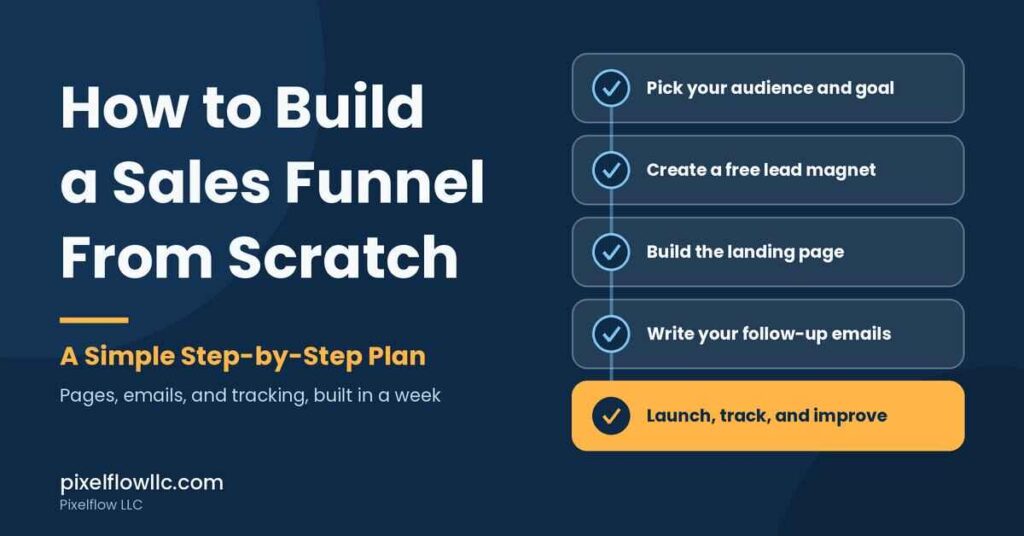
How to Build Your First Sales Funnel: A Seven-Step Plan
Here’s a practical path you can follow this week.
Step 1: Get clear on who you’re helping
Write one sentence: “I help [type of person] with [specific problem].” If you can’t finish that sentence, pause here. A funnel built for “everyone” attracts no one.
Step 2: Choose one offer
What do you want people to buy or book at the end? Pick a single main offer for this funnel. Trying to sell five things in one funnel confuses people.
Step 3: Create a lead magnet
This is the free thing that gets people to join your list. Good ones are short, specific, and quick to use: a checklist, a template, a mini-guide, a 5-day email lesson, a short video. Solve one small problem well. Don’t make it a 60-page document nobody finishes.
Step 4: Build your landing page
Keep it simple. A clear headline that states the benefit, a few short points about what they’ll get, and a form. Remove menus and distractions so there’s only one action to take.
Step 5: Write your follow-up emails
Aim for three to six emails sent over a week or two. A good rhythm looks like this:
- Email 1: Deliver the freebie and say hello.
- Email 2: Share a quick, useful tip or story.
- Email 3: Answer a common question or objection.
- Email 4: Show a real result or testimonial.
- Email 5: Introduce your offer with a clear next step.
- Email 6: A gentle last reminder.
Write the way you talk. If an email sounds like a brochure, rewrite it.
Step 6: Add automation and tracking
Set up your tools so the emails send automatically, new leads are tagged, and you’re notified when someone replies or books. Our look at GoHighLevel automation shows what this looks like inside one platform.
Step 7: Test, launch, and improve
Run through the entire funnel yourself as if you were a stranger. Click every button, read every email on your phone, and fix anything confusing. Then launch, and check your numbers after two to four weeks.
Start with one funnel. Get it working. Then build the next.
Which Tools Do You Need?
You can build a funnel with a handful of separate tools: a website builder, an email platform, a form tool, a calendar, and a payment processor. It works, but connecting them all can feel like juggling.
Many people prefer an all-in-one platform that includes landing pages, forms, email and text messaging, a CRM, scheduling, and automation under one roof. That’s where options like ClickFunnels, Systeme.io, HubSpot, ActiveCampaign, and GoHighLevel come in.
We’ve put together honest comparisons if you’re deciding: GoHighLevel vs ClickFunnels and GoHighLevel vs Systeme.io. If you want a full picture of one platform, including its downsides, read our GoHighLevel review, take a look at its features, or see what the pricing looks like. And if you’d rather test the waters first, our free trial guide explains what to expect.
A quick, honest note: no tool will rescue a weak offer or a confusing message. Start with your process, then pick the software that fits it, not the other way around.
Common Sales Funnel Mistakes (And How to Avoid Them)
Most funnels don’t fail because of the tools. They fail because of a few predictable habits.
Starting with software instead of strategy
People sign up for a platform, get excited, and build pages before they know who they’re talking to. Plan first. Build second.
Asking for too much too soon
If your first step is “Buy my $2,000 program,” most people will bounce. Ask for something small first, like an email address.
A weak or vague lead magnet
“Subscribe to my newsletter” is not a reason to hand over an email. A specific, useful freebie is.
Too many choices on one page
Every extra button, link, or option reduces the chance someone completes the main action. One page, one goal.
Ignoring follow-up
The money is often in the follow-up, not the first click. Most people need several touches before they buy.
Sounding like an ad
Emails that read like sales flyers get ignored. Share real stories, honest advice, and useful tips. Then make your offer.
Never checking the numbers
If you don’t know where people drop off, you’re guessing. Look at your numbers regularly and fix the weakest step first.
Making promises you can’t keep
Overhyped claims might win a click, but they cost you trust. If you share results or testimonials, keep them honest and clearly labeled. The FTC publishes guidance on this in its endorsement guides FAQ.
Skipping the legal basics
If you collect emails or send texts, get permission and give people an easy way to unsubscribe. The FTC’s CAN-SPAM guide is a solid starting point. We’re not lawyers, so check with a professional about your specific situation.
How to Measure Whether Your Funnel Is Working
You don’t need fancy dashboards. A few simple numbers tell you most of what you need.
- Landing page conversion rate: Of the people who visit your page, how many sign up?
- Email open and click rates: Are people reading and engaging?
- Lead-to-call or lead-to-customer rate: Of the people on your list, how many book or buy?
- Drop-off points: Where do most people stop?
- Cost per lead and cost per customer: If you run ads, are you spending more than you earn?
- Customer lifetime value: How much does the average customer spend over time?
Change one thing at a time so you can tell what made the difference. Rewrite a headline, test a new freebie, shorten a form, adjust an email subject line. Small tweaks add up.
Frequently Asked Questions About Sales Funnels
What is a sales funnel in simple words?
It’s the step-by-step path that turns a stranger into a customer. Each step moves them closer to a buying decision.
Do I need a sales funnel for a small business?
If you want predictable leads and sales online, yes, even a very simple one helps. A basic funnel can be just a landing page, a form, and a few follow-up emails.
How long does it take to build a sales funnel?
A simple one can be live in a weekend. A more advanced setup with multiple offers and automations may take a few weeks to build and refine.
How much does a sales funnel cost?
It depends on your tools and whether you run ads. You can start with low-cost tools and simple pages, then upgrade as you grow. The bigger cost is usually your time to plan it well.
What’s the difference between a sales funnel and a website?
A website is a general place for information. A funnel is a focused path designed to guide a visitor to one specific action.
What is a lead magnet?
It’s a free resource you offer in exchange for a visitor’s email address, like a checklist, guide, template, or mini-course.
Can a sales funnel work without paid ads?
Yes. Many funnels get traffic from search, social media, referrals, and content like blog posts. Ads can speed things up, but they’re not required.
How many emails should a funnel have?
Three to six is a good starting point. What matters more is that each email is genuinely useful.
Will a funnel work for services as well as products?
Absolutely. Service businesses often benefit the most, since a funnel can build trust and book calls before a single conversation happens.
Final Thoughts: A Funnel Is Just a Helpful Path
So, what is a sales funnel? It’s a simple idea with a fancy name: a clear path that helps the right people get from “I’ve just heard of you” to “I’m glad I chose you.”
You don’t need a huge audience, a big budget, or advanced tech skills. You need a clear message, one good offer, a helpful freebie, and a handful of honest follow-up messages. Build that, watch what happens, and improve it a little at a time.
If you’re ready to keep learning, here’s where I’d go next:
- Browse our sales funnel articles for more beginner-friendly guides.
- Learn how to fill the top of your funnel with our lead generation guides.
- Explore our marketing automation articles to put the follow-up on autopilot.
- Grab practical checklists from our free resources.
Ready to build a funnel that actually works for your business? Visit Pixelflow LLC for tutorials, honest software reviews, and step-by-step guides made for beginners. Start with one simple funnel, and let it do the heavy lifting while you focus on serving your customers.
About the author: This article was written by the Pixelflow LLC team, an independent resource covering sales funnels, CRM software, and marketing automation. Pixelflow LLC is not the official website of any software company mentioned. We review tools based on how they work in real business situations and disclose affiliate relationships openly.