What is lead generation? It’s the process of attracting people who might want what you sell and getting their permission to stay in touch. A “lead” is simply someone who has shown interest, usually by sharing an email address or phone number, a form submission, or a message. Lead generation is how you find those people and bring them in.
Think about the last time you filled out a form for a free guide, a quote, or a trial. You became a lead. Somewhere, a business was on the other side of that form, hoping you’d become a customer.
This guide explains how lead generation works in plain English. You’ll learn what leads are, where they come from, which methods suit beginners, and how to build a simple system that brings in new people week after week, without feeling pushy or spammy.
What Is Lead Generation, Explained Simply
Let’s skip the jargon and use a real-world picture.
Imagine you open a small bakery. People walk by every day. Some peek through the window. A few step in. Fewer still buy something.
Now suppose you put a sign outside: “Free cookie. Just tell us your name and email, and we’ll let you know when we bake fresh batches.” Someone steps in, grabs the cookie, and leaves their email. You now have a way to reach them again.
That’s lead generation. You offered something small and useful. They gave you permission to follow up. And the next time you bake a fresh batch, you can tell them.
Online, the “free cookie” is called a lead magnet, and the sign is a landing page. Same idea, different setting.
What lead generation is not
It isn’t buying a random list of emails. It isn’t blasting messages to strangers. And it isn’t a trick to get people’s details under false pretenses.
Good lead generation is an honest swap: you give something valuable, and they choose to share their contact details. Everyone’s happy, and the relationship starts on the right foot.
A Short Story: The Plumber Who Waited for the Phone to Ring
Here’s a situation that plays out in thousands of small businesses.
Say you run a plumbing company. For years, almost all your work came from word of mouth. It was great, until a slow winter hit. Referrals dried up, and your phone barely rang.
You had a website, but it was basically an online business card: your name, a phone number, a list of services. If a visitor wasn’t ready to call a stranger right then, they left. And you had no idea they’d even been there.
Now picture the same plumber with a simple lead generation setup. The website has a clear “Get a Free Quote” form. A short guide, “5 Warning Signs Your Water Heater Is About to Fail,” is available for download. Each form submission lands in a simple contact system, triggers an instant text reply, and reminds the plumber to follow up.
Same plumber. Same skills. But now, instead of waiting for the phone to ring, there’s a steady stream of people raising their hands.
This is the real power of lead generation. It turns your business from “hoping someone calls” into “knowing who’s interested.”
Why Lead Generation Matters
Let’s be honest about why this matters beyond the textbook answer.
Sales don’t happen without conversations
You can’t sell to someone you never meet. Leads are the starting point of nearly every sale.
Referrals alone aren’t predictable
Word of mouth is wonderful, but you can’t control when it comes. A steady lead system smooths out the slow months.
Most people aren’t ready to buy right away
Someone might need your service in three months, not today. If you capture their details now, you’re there when they’re ready. If you don’t, they forget you.
It lets you build trust first
When someone downloads your guide or joins your list, you get a chance to show you know your stuff before you ask for money.
It gives you something to measure
When you know how many leads you get and where they come from, you can finally make smart choices instead of guessing.
Types of Leads (Quick and Painless)
You’ll hear a few terms thrown around. Here’s what they mean in simple language.
Cold leads. People who barely know you. They may have clicked an ad or visited once. They need warming up.
Warm leads. People who’ve shown clear interest, like downloading your guide, joining your list, or reading several of your posts.
Hot leads. People who are actively ready to buy, such as someone who requested a quote or booked a call.
Bigger companies also use labels like “marketing qualified” and “sales qualified” leads. As a beginner, you can ignore those. Just remember that different leads need different follow-up. A hot lead needs a quick, personal reply. A cold lead needs patience and useful content.
Inbound vs. Outbound Lead Generation
There are two broad approaches, and most businesses use a mix.
Inbound: you attract people to you
This includes blog posts, search results, social media, videos, free guides, and referrals. People find you because they’re already searching for help or interested in your topic.
Pros: Builds trust, tends to bring warmer leads, and keeps working over time.
Cons: Takes time to build momentum.
Outbound: you reach out to people
This includes cold emails, cold calls, direct messages, and paid ads. You start the conversation.
Pros: Faster results, more control over who you reach.
Cons: Can feel pushy if done poorly, and requires care with legal rules and consent.
If you’re just starting, I’d lean toward inbound methods as your foundation, then add outbound once you have a clear message that works.
Nine Lead Generation Methods Beginners Can Actually Use
You don’t need all of these. Pick two or three that fit your business and your energy.
1. Helpful content (blog posts and guides)
When someone searches “how to fix a slow drain” or “what is a sales funnel,” your article can be the one they find. Write about the questions your customers actually ask, and include a clear next step at the end, like a free checklist or a booking link.
2. Lead magnets
A lead magnet is a free resource offered in exchange for an email address. The best ones solve one small problem quickly. Ideas that work well:
- A checklist or cheat sheet
- A short template people can copy
- A mini-guide or ebook (keep it short)
- A free quiz or assessment
- A short video lesson or email course
- A free consultation or audit
3. Landing pages
A landing page is a single page with one purpose, such as getting people to claim your freebie or book a call. No menus, no distractions. Just a clear headline, a few benefits, and a form. We cover how this fits into the bigger picture in our guide to what a sales funnel is.
4. Social media
Share useful tips, behind-the-scenes stories, and answers to common questions. Put a link to your freebie or booking page in your bio and mention it naturally in your posts. Don’t just post and hope; always give people a next step.
5. Search engine optimization (SEO)
Optimizing your website so it shows up when people search for your topic. It’s slower than ads, but it keeps bringing visitors long after you’ve published. Local businesses should also set up and maintain a Google Business Profile.
6. Paid advertising
Ads on Google, Facebook, Instagram, or other platforms can send traffic to your landing page quickly. They work best when you already know your offer converts, so test with a small budget before scaling.
7. Referrals and partnerships
Ask happy customers to recommend you. Team up with businesses that serve the same audience without competing, such as a wedding photographer partnering with a florist. A simple “thanks for the referral” gesture goes a long way.
8. Webinars and workshops
A free live or recorded session on a topic your audience cares about. People register with their email, you teach something useful, and you present your offer at the end.
9. Email outreach (done respectfully)
Reaching out directly to people who’d genuinely benefit from your offer. Keep it personal, short, and relevant. Never buy lists, and always follow the rules around consent and unsubscribing.
What Makes a Good Lead Magnet?
Since lead magnets are the engine of most beginner lead generation, they deserve a closer look.
A good one is:
- Specific. “A 5-day plan to fix your morning routine” beats “Productivity Tips.”
- Quick to use. People want a win in minutes, not a 60-page document they’ll never finish.
- Connected to your paid offer. If you sell bookkeeping, a tax prep checklist makes sense. A recipe collection doesn’t.
- Genuinely helpful. If it feels like a thinly disguised sales pitch, people will notice.
A quick test: would you hand over your email for it? If you hesitate, rework it.
What a Simple Lead Generation System Looks Like
Let’s put the pieces together so it doesn’t feel abstract. A basic system has five parts.
1. Traffic. People find you through content, social media, search, ads, or referrals.
2. A landing page and form. Visitors see a clear offer and sign up.
3. A place to store leads. A contact system that tracks who they are, how they found you, and what’s next. If this is new to you, our beginner’s guide to what CRM software is explains it from scratch.
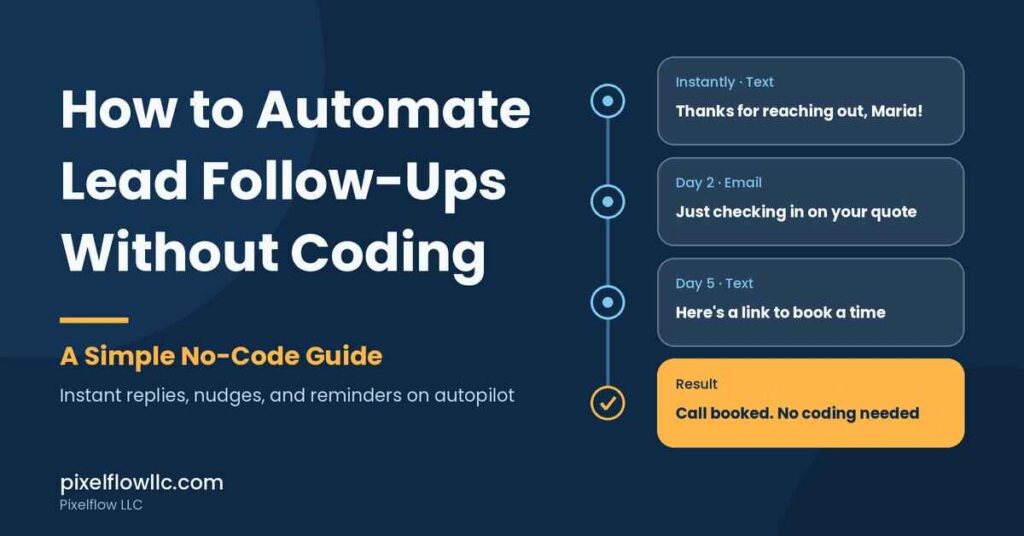
4. Automatic follow-up. A welcome message, a few helpful emails or texts, and reminders for you. Our post on what marketing automation is shows how this works without feeling robotic.
5. A clear next step. A call to book, a quote to request, a product to buy.
That’s the whole machine. Each part is simple. The magic is in connecting them so leads don’t fall through the cracks.
Lead Generation vs. Lead Nurturing
People mix these up, so here’s the difference.
Lead generation is getting someone to raise their hand.
Lead nurturing is building the relationship afterward, so that when they’re ready, they choose you.
Most beginners put all their energy into the first and ignore the second. That’s a mistake. A lead who hears nothing from you for three weeks has likely forgotten who you are. A lead who receives a few genuinely useful messages remembers you and trusts you.
A simple nurture sequence might look like this:
- Day 0: Deliver the freebie and say hello.
- Day 2: Share a quick tip or short story.
- Day 4: Answer a common question or concern.
- Day 6: Show a real example or customer result.
- Day 8: Invite them to take the next step.
Keep each message short, honest, and useful.
Who Benefits From Lead Generation?
Honestly, almost any business that wants new customers. But the style varies.
- Small businesses use forms, quotes, and booking pages to capture inquiries. See more on our small business page.
- Coaches and consultants use freebies and discovery calls to attract clients. Here’s how that works for coaches.
- Marketing agencies generate leads for themselves and for clients. Our agency page explains more.
- Real estate professionals attract buyers and sellers with local guides and home valuation requests. See details for real estate.
- Local service businesses rely on quote forms, reviews, and local search. Read more for local businesses.
Tools That Make Lead Generation Easier
You can piece together a lead generation setup with separate tools: a website, a form builder, an email platform, a calendar, and a spreadsheet. That works fine to start.
As you grow, many people prefer an all-in-one platform that combines landing pages, forms, a CRM, email and text messaging, scheduling, and automation. Options in this space include HubSpot, ActiveCampaign, ClickFunnels, Systeme.io, and GoHighLevel.
If you’re comparing, our honest breakdowns may help: GoHighLevel vs HubSpot, GoHighLevel vs ActiveCampaign, and GoHighLevel vs ClickFunnels. For a fuller picture of one platform, including its downsides, read our GoHighLevel review, explore its features, or check the pricing. If you’d rather test it first, our free trial guide explains what to expect.
One honest note: tools don’t fix an unclear offer. Get your message right first, then choose software that supports it.
Common Lead Generation Mistakes (And How to Avoid Them)
Most struggles come from a handful of habits. Here are the ones I’d watch for.
Being vague about who you help
“We help everyone” attracts no one. Say exactly who your ideal customer is and what problem you solve for them.
Weak or boring offers
If your freebie is “Subscribe for updates,” don’t expect much. Give people a clear, specific reason to sign up.
Long, complicated forms
Every extra field lowers the number of people who finish. For most freebies, name and email are enough.
Slow follow-up
Leads cool off quickly. Someone who requested a quote this morning may have contacted three competitors by lunch. Reply fast, even if it’s an automatic first message.
Chasing quantity over quality
A hundred random leads who’ll never buy are worse than ten who genuinely need what you offer. Focus on the right people.
Ignoring leads once they sign up
Leads who hear nothing go cold. Follow up, and keep following up with value.
Buying email lists
It’s tempting, but it’s a bad idea. Those people never asked to hear from you, so open rates are poor, spam complaints rise, and you risk legal trouble and a damaged reputation.
Not tracking anything
If you don’t know where leads come from, you can’t tell what’s working. Even a simple tracking note helps.
Overpromising
Hype might get a click, but it costs trust. Be honest about what your freebie and your service actually deliver.
Skipping the legal basics
If you collect emails or send texts, get permission and give people an easy way to opt out. The FTC’s CAN-SPAM compliance guide is a good starting point, and its guide to protecting personal information is worth reading since you’ll be storing people’s details. We’re not lawyers, so check with a professional about your specific situation.
A Simple Seven-Step Plan to Start Generating Leads
Here’s a practical path you can follow starting this week.
Step 1: Define your ideal customer
Write one sentence: “I help [type of person] solve [specific problem].” Be as specific as you can.
Step 2: Pick one main offer
What do you ultimately want leads to buy or book? Choose one. Trying to promote five things at once confuses people.
Step 3: Create a lead magnet
Make something simple that solves one small problem related to your offer. A one-page checklist is a perfectly good start.
Step 4: Build a landing page
Keep it focused: a clear headline, three or four benefits, and a short form. Remove anything that distracts from the single action.
Step 5: Choose one or two traffic sources
Don’t try to be everywhere. Pick the channels where your audience actually spends time, whether that’s search, Instagram, local referrals, or something else.
Step 6: Set up follow-up
Write a short welcome message and three to five follow-up emails. Make sure new leads get a reply quickly. Automation can handle this. Here’s how it works in practice with GoHighLevel automation, and you can see how contacts are organized in its CRM.
Step 7: Review and improve
Check your numbers every couple of weeks. Which source brings the most leads? Which messages get replies? Fix the weakest step first, and change one thing at a time.
Start small. One lead magnet, one landing page, one traffic source. Get that working before you add more.
How to Measure Your Lead Generation
You don’t need complicated dashboards. Track a few simple numbers:
- Number of new leads per week or month.
- Lead source: Where did they come from?
- Landing page conversion rate: Of the visitors, how many signed up?
- Response time: How fast do you reply to new leads?
- Lead-to-customer rate: Of all your leads, how many became buyers?
- Cost per lead: If you run ads, how much does each lead cost you?
- Lead quality: Are these people a good fit, or mostly tire-kickers?
If your lead count is high but sales are low, the issue is often lead quality or follow-up, not volume. If your lead count is low, look at your offer, your landing page, or your traffic.
Frequently Asked Questions About Lead Generation
What is lead generation in simple words?
It’s attracting people who might want what you sell and getting their permission to follow up, usually by collecting an email address or other contact details.
What is a lead?
A lead is a person or business that has shown interest in what you offer, often by filling out a form, requesting a quote, or messaging you.
Is lead generation only for big companies?
No. Small businesses and solo entrepreneurs often benefit the most, because every new customer matters. Even a simple form and a freebie can make a difference.
How much does lead generation cost?
It depends on your methods. Content, social media, and referrals cost mostly time. Paid ads cost money for every click. Many beginners start with free or low-cost methods and add ads later.
How long does it take to see results?
Paid ads can bring leads within days. Content and SEO usually take a few months to build momentum. Referrals and direct outreach fall somewhere in between.
What is a lead magnet?
It’s a free resource, like a checklist, template, guide, or mini-course, that you offer in exchange for someone’s contact details.
What’s the difference between a lead and a customer?
A lead is someone who’s shown interest. A customer is someone who has bought from you. The goal is to guide leads toward becoming customers.
Do I need a website for lead generation?
It helps a lot, since a website gives you a place to send people and collect their details. But you can also start with a simple landing page or a booking link.
Is it legal to collect leads and email them?
Generally yes, as long as you follow the rules, such as getting permission, being honest about who you are, and offering an easy way to unsubscribe. Laws vary by country, so check requirements that apply to you.
Final Thoughts: Lead Generation Is About Starting Conversations
So, what is lead generation? It’s a simple idea: invite the right people in, offer something genuinely useful, and ask permission to keep in touch. Everything else is just the machinery that makes that happen smoothly.
You don’t need a huge budget, a big audience, or advanced tech skills. You need a clear message, one helpful freebie, a simple way to capture details, and the habit of following up with value. Do that consistently, and your business shifts from hoping for customers to welcoming them.
If you’re ready to keep going, here’s where I’d head next:
- Browse our lead generation articles for more beginner-friendly guides.
- Learn how to turn leads into buyers with our sales funnel articles.
- Explore our marketing automation guides to handle follow-up automatically.
- Grab practical checklists from our free resources.
Ready to bring in more leads without the guesswork? Visit Pixelflow LLC for tutorials, honest software reviews, and step-by-step guides made for beginners. Start with one simple offer, one landing page, and one follow-up message, and build from there.
About the author: This article was written by the Pixelflow LLC team, an independent resource covering lead generation, CRM software, sales funnels, and marketing automation. Pixelflow LLC is not the official website of any software company mentioned. We review tools based on how they work in real business situations and disclose affiliate relationships openly.